10 Puffer Jacket Buying Tips for Global Buyers

Choosing a Puffer Jacket for international markets takes more than comparing prices and colors. Buyers must consider warmth, weight, construction, sizing, and the needs of their customers. A jacket that performs well in a cold, dry climate may feel uncomfortable in damp or milder conditions. Small details matter. The feel of the shell, the smoothness of the zipper, and the finish around the cuffs can all influence a customer’s decision.

This guide shares ten practical buying tips for global buyers, from reviewing insulation and fabric specifications to checking samples and discussing production timelines. Ask suppliers to explain whether the filling is down or synthetic, how warmth claims are assessed, and what care instructions apply. Compare size charts with actual measurements; labels alone can be misleading. Inspect stitching, pockets, closures, and packaging in a physical sample whenever possible. A product sheet helps, but it cannot show every detail. I have seen teams overlook small fit differences, then spend time revising their plans.

Reliable sourcing also depends on clear communication. Confirm minimum order quantities, available colors, lead times, and the documents that support material or performance claims. Requirements and customer expectations vary by market, so verify relevant details with qualified local professionals. No checklist can remove every uncertainty. Still, asking specific questions early can prevent avoidable surprises and help buyers choose a Puffer Jacket that suits both the intended use and the business plan.
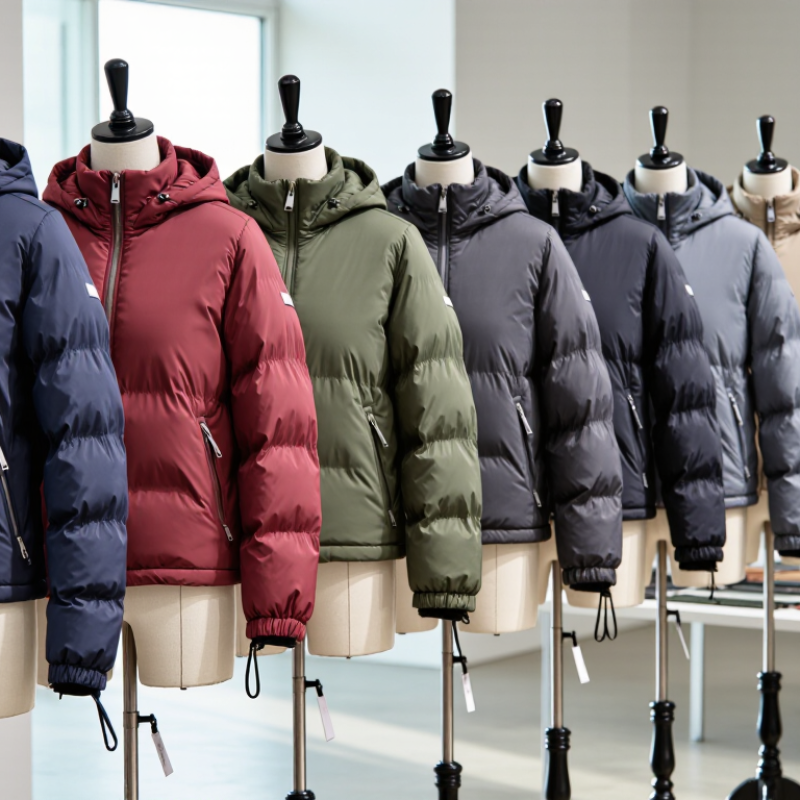
10 Puffer Jacket Buying Tips for Global Buyers

Map Target Climate and Use to ISO 11092 Thermal-Resistance Testing

Global buyers should map a puffer jacket to its likely weather and activity before comparing insulation claims. A jacket for cold, dry commuting may need different thermal performance from one worn during damp, stop-and-start travel. Consider typical temperatures, wind exposure, time outdoors, and the layers worn underneath. Small details matter: a loose cuff can let cold air in, while a thick lining may feel clammy during a brisk walk.

For fabric comparisons, request ISO 11092 results for thermal resistance, reported as Rct, and water-vapour resistance, reported as Ret. The standard uses a sweating guarded hotplate under controlled laboratory conditions. That matters. It can help compare shell, lining, or insulation materials tested in similar ways, but it does not certify how warm a finished jacket will feel in every setting. Fit, quilting, fill distribution, closures, and air leakage also affect comfort.

Read the figures in context. Higher Rct generally indicates greater resistance to heat loss; lower Ret generally means water vapour passes through more readily. Still, lab numbers can look cleaner than real life. A jacket that performs well while standing may feel too warm on a steep walk. Ask suppliers which component was tested, and whether samples and conditions were consistent. Then weigh the results against the intended climate, activity level, and layering plan. The numbers help, but they are not the whole decision.

Compare 550–900 cuin Fill Power with Down Fill Weight

A 550–900 cuin fill-power label describes down’s loft, not the total amount inside a jacket. Higher-fill-power down can trap more air per ounce, so a jacket may feel lighter without using as much fill. But the number alone cannot tell you how warm the garment will be.

Check down fill weight too, usually listed in grams or ounces. For example, a jacket with 80 grams of 900 cuin down may feel less substantial than one with 150 grams of 550 cuin down. That matters. Compare jackets in similar sizes, and ask whether the stated weight covers the whole garment or only a sample. Baffle design, fit, fabric, and draft control also affect warmth. Two labels do not tell the whole story.

For bulk orders, request a filled sample and weigh it. Inspect the baffles for thin spots, especially around the shoulders and cuffs. Ask the supplier to confirm both fill power and fill weight in writing, and check that production samples match. Higher fill power often costs more, but it may reduce packed bulk. Not always. I would be cautious about choosing on loft alone; a sleek sample can still feel cold when its fill weight is low or its baffles shift.

Verify Down Composition and Labeling Against EN 12934

A puffer jacket’s warmth depends on more than the word “down” on its label. Ask suppliers to identify the filling composition using EN 12934, the European standard for labeling down and feather mixtures. The label should state the declared components clearly, including their proportions where required. Vague wording makes comparison difficult.

Check the paperwork against the physical shipment. Request a recent test report from a competent laboratory, and confirm that its sample matches the jacket’s filling lot. Compare the report, care label, and purchase specification line by line. A small difference in down-to-feather content can affect loft, weight, and price. Keep a retained sample for follow-up checks. Paperwork can still be wrong.

Ask how the filling was sampled and tested; results are only useful when methods and samples are traceable. If a label lists a high down percentage, but the jacket feels unusually flat or uneven, pause and investigate rather than relying on touch alone. Feel is not proof. EN 12934 addresses composition labeling, not every performance claim, so assess warmth and construction separately. One detail buyers sometimes miss: translated labels can introduce inconsistencies. Have technical terms reviewed before production, and approve the final label artwork alongside the test documentation.

10 Puffer Jacket Buying Tips for Global Buyers — Verify Down Composition and Labeling Against EN 12934

Illustrative down-to-feather composition ratios shown as percentages. These examples are not market data or EN 12934 class thresholds.

Buyer check: Confirm that the declared down and feather percentages are clearly labeled and supported by relevant test documentation. Composition describes the filling mix; it is not a warmth or fill-power rating.

Assess Shell Air Permeability Using ISO 9237 Test Data

For a puffer jacket, shell air permeability affects wind protection, but a low number alone does not prove better performance. Request an ISO 9237 test report for the exact shell fabric, not a similar product. The standard measures airflow through a known fabric area under a stated pressure difference. Results may be reported in mm/s or L/m²/s; these units are numerically equivalent. Check the test pressure, test area, conditioning details, and laboratory information before comparing suppliers.

Look for both the average and individual readings. A shell tested at 100 Pa cannot be fairly compared with one tested at another pressure. Ask whether measurements came from several fabric locations, especially near coatings or laminations, where variation can occur. The ISO 9237 method describes how to measure air permeability; it does not set one universal pass mark for puffer jackets. That part is easy to overlook.

Pair the result with construction checks. Hold a swatch near a fan, then inspect stitching, zipper covers, and seam tape: air can enter through garment details even when the fabric performs well. Request the report date and fabric lot number, too. One sample is not the whole production run. I would still treat a tidy test sheet cautiously; repeat testing can reveal differences that a single average hides.

10 Puffer Jacket Buying Tips for Global Buyers - Assess Shell Air Permeability Using ISO 9237 Test Data

Use this buyer checklist to specify and review shell-fabric air-permeability testing. Example screening ranges below are illustrative buyer-defined starting points—not ISO 9237 limits or actual laboratory results. Agree on test conditions and acceptance criteria with your supplier and laboratory.

# Buying tip What to specify or review Example data / buyer screening guide Why it matters
1 Request an ISO 9237 report Ask for the standard edition, test date, laboratory identification, specimen description, and reported air-permeability unit. Report air permeability in mm/s and identify the pressure difference used. A number without its test conditions is difficult to compare or interpret.
2 Agree on the pressure difference Specify the pressure difference (Δp) before testing and use the same value when comparing fabrics. Example test-plan entry: Δp = 100 Pa, if appropriate for the product and agreed by the parties. Results taken at different pressure differences may not be directly comparable.
3 Set the acceptance range for your use case Define a buyer-specific target for the shell at the agreed test conditions; do not treat a screening range as an ISO pass/fail limit. Illustrative starting bands: 0–10 mm/s (lower air flow); >10–30 mm/s (moderate air flow); >30 mm/s (higher air flow). Lower air permeability can support wind resistance, while a higher value may be preferred where air exchange is a priority. These bands are not universal specifications.
4 Confirm the tested material matches production Match the report to the production shell, including fiber, weave or knit, coating or membrane, and finish. Record a fabric code, construction, finish, and production lot for each sample set. Changes in construction or finishing can change air permeability; a report for a different fabric is not a reliable substitute.
5 Check sampling and reported variation Ask for the number of specimens tested and individual results or summary statistics, and define the sampling plan with the laboratory. Review the mean, minimum–maximum, and standard deviation when provided; compare like-for-like specimen counts. Variation across specimens can reveal fabric or finishing inconsistency that a single result may hide.
6 Record conditioning and specimen details Request the conditioning details and test area or test-head information stated in the report; follow the applicable standard and laboratory procedure. Keep conditioning and apparatus details consistent across development and bulk-production checks. Environmental and test setup differences can affect comparisons between reports.
7 Test shell and lining separately Identify whether each result is for the shell fabric, lining fabric, or a layered assembly. Use separate, clearly labeled results for shell and lining when both are relevant. A garment’s air exchange depends on its overall construction; a shell-only measurement does not describe every layer.
8 Recheck after relevant finishing or aging If durability matters, agree whether to test the fabric as received and after a defined laundering or aging procedure. Compare before-and-after results only when the treatment, number of cycles, and test conditions are documented. Finishes and use-related changes may affect measured air permeability; results depend on the treatment used.
9 Do not use air permeability as a down-leakage test Specify a separate, suitable evaluation for down or feather leakage and assess seams and construction. Treat ISO 9237 air-permeability results as fabric airflow data, not proof of down-proof performance. Airflow through fabric and leakage of filling through fabric or seams are different performance questions.
10 Validate the finished jacket Use fabric test results alongside garment-level review of seams, closures, quilting, fit, and intended climate. Keep a signed fabric specification, approved sample, report, and bulk-lot check record. ISO 9237 measures air permeability of a fabric specimen; it does not measure the complete jacket’s warmth or wind protection.

Note: ISO 9237 specifies a method for determining air permeability of textile fabrics. The pressure difference, test area, sampling, and acceptance limits should be stated in the agreed test plan and report.

Check Fit, Traceability, and Import Compliance Before Ordering

10 Puffer Jacket Buying Tips for Global Buyers

Check fit with garment measurements, not just size labels. Compare chest width, sleeve length, and back length against a jacket that fits your target customer. Ask for a sample worn over a sweater; thin-shirt fittings can hide tight shoulders. Confirm fill weight and baffle construction, too. A jacket may look lofty on a hanger but feel restrictive when zipped. Small details matter.

Tip: Request a size chart, sample, and written measurement tolerances before placing a bulk order. For traceability, ask who supplies the shell fabric, lining, and insulation. Keep mill details, batch references, and purchase records together. If a supplier cannot explain where materials come from, pause and ask again. A neat spreadsheet helps, though it cannot replace clear records from the supplier.

Before production, check the importing market’s current rules with your customs broker or compliance specialist. Confirm required fiber and care information, origin marking, test reports, and shipping documents for your product and destination. Requirements can vary, and a label accepted in one market may not suit another. Review a physical label sample before mass production. I would not assume a familiar template is still correct; that assumption is easy to make, and worth challenging.